Category: Raising Kids

Practical ideas and real experiences for navigating the everyday work of raising young kids.

  • We Made It Through No TV September. Here’s What Actually Happened.

    We Made It Through No TV September. Here’s What Actually Happened.

    No TV September was a success. It was also a failure in a lot of ways. And I think that’s probably why I’m glad we did it.

    When we started this challenge, one of my biggest goals was pretty simple: I wanted my boys to get better at playing independently. I didn’t expect them to suddenly entertain themselves for hours. But I wanted them to be able to go into a room, find something to do, and play without needing Mom or Dad involved every second. When we started No TV September, we didn’t know exactly what the month would expose.

    At first, that went terribly.

    They didn’t want to play by themselves. They wanted my wife or me there with them constantly. Taking TV away didn’t magically make them independent. Instead, it exposed the fact that they didn’t really know what to do when we weren’t entertaining them.

    And honestly, sometimes we didn’t know what to do either.

    The Tiny Timer That Made a Big Difference

    One of the simplest things we tried ended up helping more than I expected. We found a little visual timer with buttons for 1, 3, 8, 10, and 15 minutes. We would turn it on and give the boys a small amount of time to play independently.

    That was it. We weren’t telling them to disappear for an hour. We were giving them something they could see and understand. A few minutes. Then we’d come back.

    That little timer became a breakthrough. Independent play didn’t suddenly become easy, but it started becoming possible.

    We also learned that sometimes telling our kids, “Go play,” wasn’t enough. If they were bored, one of us could go into the room with them, start building something or get a game going, and then slowly step away. A lot of times, they just kept playing. By two weeks without TV, that shift was already starting to show.

    That sounds incredibly simple now. But before this month, we weren’t doing it.

    Then the Library Took Off

    The library became one of the biggest surprises of the entire challenge. Without TV waiting at home, we needed other things to fill that space.

    Books became a much bigger part of our house. We started making regular library trips and bringing home new books and Tonies. The novelty helped. There was always something different for the boys to discover.

    We read a lot this month. Sometimes sitting down and reading book after book was challenging. Other times it became one of my favorite parts of the day.

    Then I started noticing something. Sometimes I’d walk into a room and find one of my boys sitting there looking through a book by himself. Nobody told him to. There wasn’t a screen competing for his attention. He was just looking at a book.

    I don’t think that happens nearly as often in our house if we don’t do this challenge.

    Not Everything Got Better

    Here’s where the nice story about a screen-free month falls apart a little. Taking away TV didn’t suddenly make our kids stop fighting.

    In some ways, their imaginative play became more intense. My older son loves pretending to be a firefighter. But he also has a very specific idea in his head about everything he needs to be a firefighter.

    If something was missing, we had a problem. If his little brother had something he believed belonged with his fire equipment, we had another problem. That became one of our regular battles this month.

    More imaginative play sometimes meant more opportunities for conflict. There were still meltdowns. There was still fighting. There were still plenty of moments when parenting two little boys was exhausting.

    No TV September didn’t fix those things.

    But It Forced Us to Deal With Them

    This might have been the most important part of the entire experiment.

    Before September, TV could be an easy answer. The kids are fighting. Turn something on. Everyone is melting down. Turn something on. Dad and Mom need a few minutes of peace. Turn something on.

    I don’t think TV is bad. We’re bringing it back. But looking back at our own family, I think we had sometimes started using it as a Band-Aid for problems we hadn’t learned how to handle yet.

    When the Band-Aid wasn’t available, we had to figure some things out.

    If the boys were fighting, we learned that sometimes we needed to separate them and give everyone time to cool down. If they were bored, we learned that telling them to “go find something to do” wasn’t always enough. Sometimes they needed us to help them get started.

    So we’d enter their play, get something going, and then gradually leave.

    We also started paying more attention to meltdowns instead of trying to make them disappear. The meltdowns didn’t go away. But their ability to recover from them seemed to improve. And our ability to handle them improved too.

    We started developing actual systems for situations that previously felt like chaos. That’s something I didn’t expect when we turned the TV off.

    The Kids Weren’t the Only Ones Changing

    My wife and I had habits around TV too. There were times when we relied on it because we needed downtime. That’s understandable. Parenting little kids is exhausting.

    But September gave us a hard rule: we’re not doing that this month.

    And somehow, we did it. That surprised both of us.

    It also made me wonder where else we could do the same thing. What other habits in our parenting or our relationship have we accepted simply because that’s how we’ve always done them? What would happen if we occasionally drew a line and said, “For the next month, we’re going to try something different?”

    We don’t have all those answers yet. But No TV September showed us that we’re capable of changing more than I thought.

    So Are We Getting Rid of TV?

    No.

    I’m actually excited to bring one part of it back: Movie Fridays.

    I enjoy them. My boys enjoy them. Sitting together and watching a movie feels different to me than simply turning on the TV because nobody knows what else to do. I can’t wait for our first Movie Friday after the challenge.

    What we haven’t decided is exactly what the rest of our TV rules will look like. We’ve talked about using TV as a reward. We’ve talked about limiting it to around 30 minutes per kid. We haven’t made the final decision.

    But I know what we’re not doing. We’re not reaching October 1, turning the TV back on, and immediately returning to everything we were doing before September.

    That would miss the entire point.

    Would I Do No TV September Again?

    Yes.

    Not because it transformed my kids. Not because our house suddenly became peaceful. And definitely not because we became perfect parents.

    I’d do it again because it exposed things. It showed us where our kids needed help learning to play independently. It showed us how much they enjoy books when we make room for them. It showed us that imaginative play can create its own problems.

    It showed us that meltdowns weren’t something we always needed to distract our way out of. And maybe most importantly, it showed my wife and me some of our own habits.

    Turning off the TV didn’t solve our parenting problems. It made some of them harder to ignore.

    And that might have been the most successful part of No TV September.

    Dads, let’s go.


    Keep Reading No TV September

    Start with why we turned off the TV, see what changed after two weeks, and read how the library became one of the biggest surprises of the experiment.
  • When My Kids Fight, I See Red

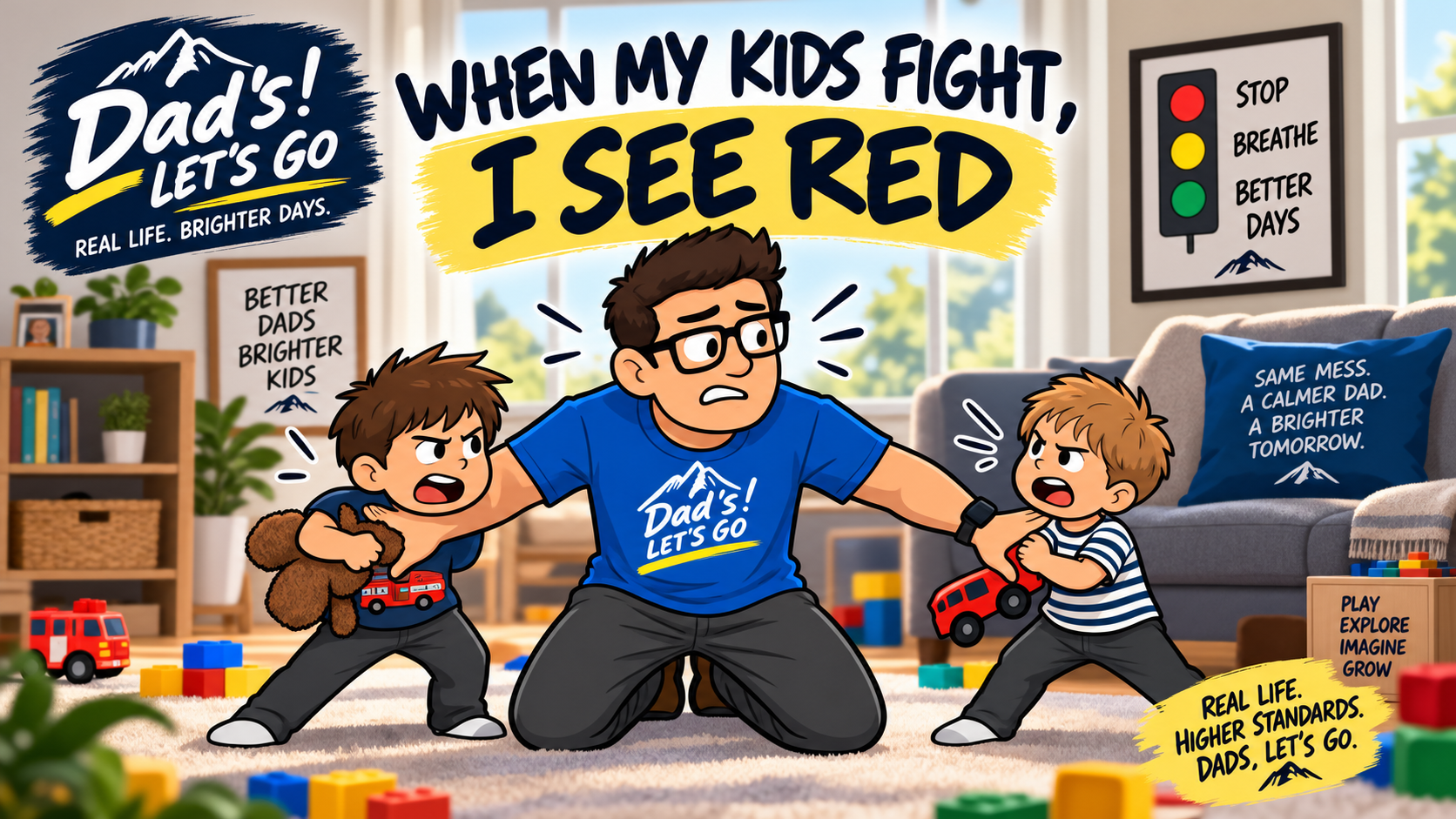
    When My Kids Fight, I See Red

    Some mornings, my boys wake up ready to fight.

    Today was one of those mornings. From the time they woke up, it felt like every time they were together they found something to argue about. I separated them. I tried to calm things down. I put them in different rooms. Then I would bring them back together, and before long we were right back where we started.

    Eventually it crossed the line from annoying sibling fighting into somebody getting hurt. One of my boys clawed the other across the face hard enough to leave fingernail marks down the side of his face. A little while later, I had to take him to school looking like that.

    And I was furious.

    The Fight Wasn’t the Only Problem

    Sibling fighting is one of those parenting situations that hits a button in me fast. I can handle a lot of noise and chaos until suddenly I can’t. When one of my kids intentionally hurts the other, that anger can go from zero to red before I have much time to think.

    My first instinct was consequence. I took away their fire gear for the day. They both love playing firefighter, so it mattered to them. But underneath the consequence was another problem I had to deal with first: me.

    I realized I was too angry to have the conversation I wanted to have with my five-year-old. So I told him, “Go to your room. Daddy is very angry right now and needs to cool down before we talk about this.”

    That might have been the most important thing I did all morning.

    I Had Already Seen the Traffic Light Change

    I’ve written before about thinking of my own regulation like a traffic light. Green means I’m okay. Yellow means the warning signs are showing up. Red means I’m no longer in a good place to solve the problem.

    This morning, I was red.

    The goal wasn’t to pretend I wasn’t angry. My kid had hurt his brother. I was angry. The goal was to keep that anger from deciding what happened next.

    So instead of trying to teach a lesson while I was furious, I created space. He went somewhere safe. His brother was taken care of. I got myself under control. The parenting conversation could wait until my brain was back online.

    That’s what the Traffic Light idea is supposed to do. It isn’t just something to read when everything is calm. It’s supposed to help me recognize, in the middle of a bad morning, that I shouldn’t keep pushing forward just because I’m Dad.

    Sometimes I Need to Turn the Volume Down is where I first started putting words around that idea.

    Stop the Fight. Then Teach.

    What I’m learning is that I don’t need to solve the entire sibling conflict while two kids are still worked up and I’m getting angry too. In that moment, the job is smaller: stop anyone from getting hurt, separate them, take care of the hurt kid, and get everybody regulated.

    The teaching comes later.

    Once things are calm, I can talk about what happened. I can set the boundary clearly: you can be mad at your brother, but you cannot hurt him. Then instead of forcing an automatic “sorry,” I can ask the kid who did the hurting to repair something.

    That repair might be getting an ice pack, checking on his brother, helping fix something that got knocked over, drawing him a picture, or asking what would help. I like that better than demanding a word that can be said without meaning anything. The point isn’t to make him perform remorse. It’s to start teaching him what we do after we’ve hurt someone.

    The Sibling Fight Reset

    I wanted something simple enough to remember when the house is loud and my patience is disappearing. So this is the reset I’m going to practice the next time the boys start going after each other:

    1. Stop. Block hitting, scratching, kicking, or anything unsafe.
    2. Separate. Give each kid his own safe space. This isn’t the time to decide who’s right.
    3. Check Dad’s light. Green? I can help. Yellow? Slow down. Red? Make sure everyone is safe and take space before talking.
    4. Regulate first. Let bodies and brains settle before trying to teach.
    5. Talk later. Hear what happened and restate the boundary once everyone can actually listen.
    6. Repair. Help the child who caused harm do something useful to make things a little better.
    7. Reset. Don’t force them right back into the same play if they’re not ready. Sometimes brothers need some space.
    The Sibling Fight Reset toolkit card with steps to stop unsafe behavior, separate, check Dad's traffic light, regulate, talk, repair, and reset.

    Not Every Fight Needs a Perfect Resolution

    I still don’t know exactly why my boys were so determined to fight today. Maybe they were tired. Maybe one woke up wrong and the other matched his energy. Maybe they’re three and five and sometimes being brothers means they can love each other at breakfast and act like mortal enemies ten minutes later.

    I don’t think my job is to prevent every fight. I’m not sure that’s even possible. My job is to keep them safe, teach them what to do with anger, and make sure my own anger doesn’t become another problem in the room.

    Today wasn’t pretty. One kid went to school with scratches on his face. Fire gear got taken away. Dad got furious.

    But I also recognized when I was red and stopped myself before trying to parent from there. That’s progress I’m willing to count.

    Keep Going

    If this is one of the things your family is working through too, you might want Sometimes I Need to Turn the Volume Down for the Dad side of regulation, or head to the Dad Resets section of the Toolkit for something practical to use in the moment.

    Dads, let’s go.

  • Two Weeks Without TV: What Happened When I Stopped Entertaining My Kids

    Two Weeks Without TV: What Happened When I Stopped Entertaining My Kids

    We’re two weeks into our no-TV experiment, and I’m not going to lie and say it’s been all rainbows.

    The first week involved a lot of bargaining. “Can we watch TV?” “What about just one show?” There was whining, complaining, and plenty of moments when turning on the TV would have been the easiest thing to do.

    Then, somewhere near the end of that first week, something happened.

    They stopped asking.

    Not completely, and not because we had some big breakthrough. The requests just started happening less and less. Eventually I realized we were getting through parts of the day without anyone even bringing up TV.

    But before we got there, I did something I hadn’t really thought about.

    I Replaced the TV With Dad

    When we turned off the TV, I felt like I needed to fill the hole it left behind. If the boys weren’t watching something, then I needed to give them something to do.

    Basically, I became the TV.

    So I started coming up with games. Pool noodles became hockey sticks. Our crash pad became a fishing boat. The stairs became a dunk tank. Our basement became the Home Games.

    And honestly, I love this part.

    Some of my favorite moments from the past couple weeks have come from me looking around the house, seeing whatever random stuff we have lying around, and figuring out how to turn it into something fun with the boys.

    But I also started realizing that I couldn’t be their entertainment all day. More importantly, maybe I shouldn’t be.

    Every time they started getting bored, I was jumping in with another idea. I had taken away the TV, but I was still filling every empty space for them.

    Then week two happened.

    They Started Figuring It Out

    I started noticing the boys finding things to do without me.

    They’d grab some toys and start playing. They’d build something. They’d make up their own game. Sometimes they’d play together, and sometimes one of them would disappear into another room and do his own thing.

    Don’t get me wrong. They still fight.

    Two weeks without TV has definitely not turned my boys into peaceful little monks.

    But I’ve noticed that even the fights seem a little different. They still get mad at each other, but the fallout seems shorter and less extreme. They seem to move on faster.

    I have no idea if that’s because of the TV.

    And I don’t want to pretend that two weeks of doing something in our house means I’ve figured out some parenting secret. Maybe it’s the lack of TV. Maybe they’re just getting used to the new routine. Maybe I’m handling things differently because I’m paying more attention to it.

    I don’t know. I just know what I’m seeing.

    It’s Happening While I Write This

    Actually, the reason I wanted to write this article is happening right now.

    I’m sitting here writing while my five-year-old is in his room playing with Magna-Tiles by himself.

    I didn’t tell him to go play. I didn’t give him an activity. I didn’t set anything up for him. I didn’t come up with some elaborate Dad Game.

    He just went into his room and started building.

    That’s it.

    It sounds like such a small thing when I write it down. A five-year-old is playing with his toys. Big deal.

    Except two weeks into this experiment, it feels like a big deal to me. Because I didn’t have to entertain him.

    Maybe They Just Needed Some Empty Space

    I started this whole thing wondering what would happen if we stopped watching TV for a while. I figured we’d play more, spend more time together, and probably hear a lot of complaining.

    All of those things happened.

    What I didn’t expect was realizing how quickly I tried to replace one form of entertainment with another.

    Me.

    I don’t want to stop playing with my boys. Quite the opposite. Some of the ridiculous games we’ve created because of this experiment are things I hope they remember someday.

    But I also don’t think I need to rescue them from boredom every time it shows up.

    Sometimes we should turn the basement into a hockey rink. Sometimes Dad should become a human dunk tank. And sometimes I can sit down and do my own thing while they figure out theirs.

    We’re only two weeks in. I’m sure there will still be days when they beg for TV. There will definitely be more fights, whining, and days when turning on a show sounds pretty good to me too.

    But right now, I’m sitting here writing while I hear Magna-Tiles clicking together in the other room.

    Maybe they just needed some empty space to figure out what to do with it.

    Dad’s! Let’s Go.


    Keep Reading No TV September

    Want to see where the experiment ended up? Read our full No TV September results and the unexpected side story of why the library became one of my favorite free things to do with my kids.

  • The Poopy Pants Monster: Why Does My Three-Year-Old Keep Pooping His Pants?

    The Poopy Pants Monster: Why Does My Three-Year-Old Keep Pooping His Pants?

    I am currently dealing with the Poopy Pants Monster.

    Lately, my three-year-old son has been hiding when he needs to poop—or sometimes just spontaneously pooping his pants. And I am at my wits’ end trying to figure out why.

    In my head, the situation seems pretty straightforward. He knows when he’s pooping. He knows where poop is supposed to go. He knows how to use the potty. So I’ve found myself thinking: He’s making the decision to poop his pants instead of going to the toilet.

    At least, that’s what it feels like.

    Today was a perfect example. We went to a playground after school, and we’d barely been there five minutes when I discovered he’d pooped his pants.

    And we’re not talking about a little accident. No. This was a full-blown poop catastrophe. Poop coming out of the underwear and down the pant leg. The kind of situation where you look at your child and realize there is absolutely no way you’re salvaging this playground trip.

    For some reason, poop accidents are a trigger for me. I don’t completely understand why yet. Maybe it’s the mess. Maybe it’s the sudden derailment of whatever we’re doing. Maybe it’s that thought running through my head: You knew you had to poop. Why didn’t you just tell me?

    Whatever the reason, I responded badly.

    Later, after I’d calmed down, I apologized to my son. We reconnected, and I made sure he knew Dad’s reaction wasn’t how I wanted to handle it. But even after repairing that moment, I was left with the same question:

    Why does my three-year-old keep pooping his pants?

    Maybe He’s Not Making the Decision I Think He’s Making

    This is the part I’ve had to reconsider.

    I’ve been looking at the situation through an adult brain. I feel the urge to poop, recognize what that feeling means, stop what I’m doing, and go to the bathroom. So when my son doesn’t do those things, it’s easy to interpret his behavior as a choice.

    He knew. He just didn’t go.

    But knowing how to use the potty and consistently recognizing when it’s time to use it aren’t necessarily the same thing.

    He’s three. There are still plenty of things he’s learning to notice and act on before they become an emergency.

    And then there’s the playground problem.

    Imagine you’re three years old. There are slides, swings, things to climb, and Dad has just unleashed you into three-year-old paradise.

    Your body sends a little message:

    Hey, buddy. We might need to poop soon.

    Your three-year-old brain responds:

    That’s interesting. Anyway… SLIDE!

    By the time that little signal becomes impossible to ignore, the Poopy Pants Monster may have already won.

    That doesn’t mean every accident is unavoidable. It means I may be giving my three-year-old a lot more deliberate control over the situation than he actually has.

    Maybe I’m Asking the Wrong Question

    Instead of asking, “Why won’t he poop in the potty?” I’m trying to ask:

    “What is getting in the way of him getting there in time?”

    Maybe he’s too busy playing. Maybe he notices but doesn’t want to stop. Maybe he waits too long. Maybe he simply hasn’t gotten consistent at recognizing when it’s time to go.

    Whatever the reason, getting angry after the poop is already in his pants isn’t helping either one of us.

    So we’re going to try something different.

    Operation: Beat the Poopy Pants Monster

    First, I’m going to stop relying so heavily on one question:

    “Do you have to poop?”

    Because if you’ve ever asked a three-year-old whether he needs to stop doing something fun and go sit on a toilet, you probably already know the answer.

    “No.”

    Instead, I’m going to start building potty attempts into predictable moments: before leaving the house, after coming home, and especially before starting something he’s likely to become completely absorbed in.

    Yes, that now includes playgrounds.

    I’m also going to start paying attention to when these accidents happen. Maybe there’s a pattern I’ve been missing.

    If the Poopy Pants Monster usually shows up around the same time every afternoon, Dad needs to stop being surprised when he arrives.

    If the monster normally attacks at 3:30, we’re going to try the potty before then.

    We’re setting a trap.

    Celebrate More Than the Poop

    I also don’t want success to mean only one thing: poop successfully deposited in toilet.

    There are smaller victories along the way. If he notices what’s happening and tells me, that’s a win. If he stops playing when it’s potty time, that’s a win. If he sits and tries, that’s a win. If he has an accident but tells me instead of hiding it, that’s progress too.

    Obviously, the ultimate goal is still poop in the toilet. I’m not lowering the bar that far.

    But he’s learning, and I want to start noticing the steps that eventually get us there instead of only reacting when they don’t.

    And When the Monster Wins?

    This is probably going to be the hardest part for me.

    I need to make accidents boring.

    “You pooped in your pants. Poop goes in the potty. Let’s get you cleaned up.”

    That’s it.

    No interrogation. No giant lecture. No Dad turning a pair of dirty underwear into the defining event of the afternoon.

    He can help with the cleanup in whatever way makes sense for a three-year-old: getting clean clothes, putting the dirty ones where they belong, washing his hands. Not because I’m trying to punish him. It’s simply part of cleaning up the mess.

    Most importantly, I don’t want my reaction teaching him to hide accidents from me.

    I want him to know he can come get Dad when he needs help.

    Dad and Kid vs. the Monster

    I haven’t defeated the Poopy Pants Monster.

    There’s no triumphant ending to this article where I reveal the secret trick that got my three-year-old perfectly potty trained in three days.

    We’re still in it.

    I’m still a dad trying to understand why my kid can confidently tell me every detail about something he saw three weeks ago but apparently can’t tell me there’s a poop making its way toward his underwear.

    But I do know what I want to change.

    I don’t want this to become Dad versus my son.

    I want it to become Dad and my son versus the Poopy Pants Monster.

    We’re going to learn his patterns. We’re going to practice getting to the potty before it’s an emergency. We’re going to celebrate when he gets it right. And when the monster occasionally wins, we’re going to clean up the mess and try again.

    Because maybe the question isn’t:

    “Why does he keep doing this?”

    Maybe it’s:

    “What does he still need Dad to help him learn?”

    That’s a question I can actually do something with.

    Even when there’s poop running down his pant leg.

    Dad’s! Let’s Go.


    Beat the Poopy Pants Monster Toolkit

    We’re using this simple tracker to practice recognizing the urge, reward the attempt, and look for patterns in what was happening before the Poopy Pants Monster showed up.

    Poopy Pants Monster Toolkit for recognizing the urge to poop, rewarding potty attempts, and tracking time and activities to spot patterns.
  • The LET’S GO Method for Kid Boredom

    The LET’S GO Method for Kid Boredom

    No-TV September sounded like a great idea. Then the TV went off and my wife and I discovered something pretty quickly: our boys expected us to become the entertainment.

    For the first few days, it felt like we spent most of the day answering some version of the same problem: What are we doing now?

    Without the easy option of turning on a show, boredom arrived fast. And when young kids are bored, they don’t always quietly wander away and invent an elaborate game. Sometimes they follow you around announcing it.

    We could keep supplying activities all day, but that wasn’t really what I wanted our month without TV to become. I didn’t want to replace one source of constant entertainment with Mom and Dad providing another.

    Maybe Boredom Isn’t the Problem

    I started thinking about boredom differently. Maybe our job isn’t to make it disappear immediately. Maybe the boys need some help learning what to do with it.

    That led me to a simple framework I can remember even when everyone is getting restless: the LET’S GO Method.

    It isn’t a magic trick for creating kids who never complain about being bored. It’s a starting point. Instead of Dad automatically producing the next activity, we can walk through a few steps that help turn boredom into curiosity, action and eventually a little more independence.

    Colorful LET’S GO Method guide showing six steps for helping kids move through boredom: Look Around, Explore Options, Try Something, Stick With It, Grow From It, and Do It Again, with examples for each step.
    The LET’S GO Method: six simple prompts for turning “I’m bored” into a starting point.

    L — Look Around

    Before we decide there’s nothing to do, look at what’s already around us. Toys we haven’t touched in a while. Blocks. Art supplies. The backyard. A pile of cardboard boxes. A trail outside. Even a room that could become the site of some ridiculous imaginary rescue mission.

    The question becomes: What do you see, hear or have around you that could become fun?

    E — Explore Options

    Now we come up with possibilities. They don’t have to be great ideas. In fact, some of the best kid ideas sound completely ridiculous to adults.

    Build a fort. Draw a map. Hunt for five blue things. Make an obstacle course. Go outside and find bugs. Turn the couch into a fire station. Dad can help get the ideas moving without deciding everything for them.

    T — Try Something

    This is where we stop discussing boredom and actually choose something.

    It doesn’t need to be the perfect activity. Pick one idea and give it a real shot. If the boys need help starting, I can start with them. The goal isn’t for Dad to run the entire game; sometimes they just need enough momentum to get moving.

    S — Stick With It

    This may be the hardest part. A new activity doesn’t always become fun in the first thirty seconds.

    Give it some time. Build another level. Change one rule. Finish what you started. Sometimes the moment when a kid says, “This is boring too,” is only a few minutes before imagination finally takes over.

    G — Grow From It

    Not every idea is going to work, and that’s useful too.

    What was fun? What wasn’t? What would we change next time? Did somebody discover something they want to do again?

    I don’t need to turn that into a formal family meeting. A quick conversation is enough. We’re helping the boys notice what they enjoy and learn that an ordinary day can become something different because of what they chose to do with it.

    O — Do It Again

    Boredom will come back. That’s not failure. That’s another chance to practice.

    Maybe yesterday’s idea becomes a favorite. Maybe they change it. Maybe they start the process themselves before I even get involved.

    That’s really what I want from this. Not children who are occupied every second of the day, but boys who slowly learn that “I’m bored” doesn’t have to mean “someone entertain me.” It can mean, Okay. What can I do next?

    Dad Doesn’t Have to Be the Entertainment Department

    No-TV September has already made something obvious in our house: removing a screen doesn’t automatically create independent play. There’s a gap between “the TV is off” and “I’m happily entertaining myself,” and the LET’S GO Method is our attempt to help the boys learn how to cross it.

    Some days we’ll still play right alongside them. I want that. Playing with my boys is part of being present. But being present doesn’t mean I have to fill every empty minute for them.

    Sometimes being a present dad means getting down on the floor and joining the adventure. Sometimes it means helping them find the first idea—and then getting out of the way long enough for it to become theirs.

    If you’re trying something similar, don’t worry about using every letter perfectly. Start with the part your kids need. Look around. Throw out a few ideas. Try one. Give it time. Talk about what worked. Then do it again the next time boredom shows up.

    Small steps. Brighter days.

    Dads, let’s go.


    Keep Reading No TV September

    This method grew out of our month without TV. See what actually happened during No TV September and how the library became one of our favorite free family outings.

  • Swim Lessons: Sometimes Dad Has to Learn, Too

    Swim Lessons: Sometimes Dad Has to Learn, Too

    Swim lessons felt like one of the easiest parenting decisions we could make. Our boys needed to learn how to be safe around water, and every lesson gave us a little more peace of mind.

    What I didn’t expect was how hard swim lessons were going to be for me.

    The Pool Was a Lot

    Walking into the YMCA pool meant noise coming from every direction. Voices bounced off the walls. Kids splashed and yelled. Whistles, echoes and movement filled the room. Add a crowd of strangers to that environment, and my anxiety was already climbing before the lesson really started.

    Then there was another piece I didn’t really want to admit: I was uncomfortable with my body. Years of being overweight and out of shape had left me embarrassed about how I looked. Being at a pool made that insecurity difficult to ignore.

    My wife could tell I hated being there. And honestly, I did.

    But Then I Watched My Boys

    The strange part was that while I dreaded the environment, I loved watching the lessons.

    Week after week, I could see the boys changing. Something they couldn’t do before suddenly became something they could. They became more comfortable in the water. They learned new skills. They were proud of themselves.

    Seeing that transformation was amazing.

    So I had two things that were both true: the pool overwhelmed me, and being there for my boys mattered to me.

    I Finally Told My Wife

    For a while, I tried to push through it. That didn’t make the noise quieter, the crowds smaller or my anxiety disappear. Eventually I was already overwhelmed, and I finally told my wife what was going on in my head.

    She listened. More importantly, she supported me in figuring out what would actually help.

    The solutions weren’t dramatic. Earplugs helped turn the volume down without removing me from the experience. A swim shirt helped me feel less exposed and less focused on how I looked. That experience eventually helped me understand my sensory overload more clearly, which I wrote about in Sometimes I Need to Turn the Volume Down.

    Neither one changed the pool. They changed my ability to handle the pool.

    Sometimes Dad Has to Learn, Too

    I used to think showing up meant you just sucked it up and did whatever needed to be done. Fatherhood keeps teaching me that there is another way.

    Sometimes showing up means admitting that something is difficult. Sometimes it means talking to your partner instead of trying to carry everything silently. Sometimes it means making a small adjustment that allows you to stay in the moment instead of spending the whole experience trying to survive it.

    My boys were at swim lessons learning how to become stronger and safer in the water.

    Apparently, Dad had something to learn there too.

    I don’t need every environment to become comfortable before I can be the dad I want to be. But I do need to understand myself well enough to know when I need help, when I need an adjustment and when I need to speak up.

    Because the goal isn’t to prove I can suffer through it.

    The goal is to keep showing up.

    Dads, let’s go.