
We recently spent ten days traveling with our two boys, ages three and five, exploring beaches, waterfalls, mountains, and everything in between. I spent hours planning our adventures, researching places to visit, hikes to take, and activities the boys would enjoy.
But you know what I didn’t spend much time planning? What we were going to do when we weren’t out exploring.
As any parent knows, just because the day’s adventures are over doesn’t mean your kids are ready to stop moving. Sometimes they seem to have more energy than when the day started.
During our trip, we came up with three simple games that helped us get through some of those moments. No fancy equipment, no expensive toys, and very little preparation. Just a dad trying to keep two energetic boys entertained without completely losing his mind.
When the Hotel Pool Isn’t an Option
We were stuck in our hotel room, and the boys had way too much energy. Normally, this is when we’d head down to the pool. It’s one of our favorite ways to let them burn off that last bit of energy before settling down for the evening.
Unfortunately, the pool wasn’t available. This time, we were stuck with just the room.
And the boys were making the most of it.
They were running around, getting into everything, and it seemed like all we were doing was telling them to stop. Don’t touch that. Stop running. Leave that alone. I was getting frustrated, they weren’t having much fun, and we weren’t getting anywhere.
I know what you’re thinking. Why not just turn on the TV?
Well, have you stayed in a hotel recently? It seems like the only things left on hotel television are sports and the news. Not exactly what I was looking for to entertain a three-year-old and a five-year-old.
So I needed another idea.
My boys love anything involving emergency responders. Firefighters, police officers, rescues. If there’s an emergency somewhere, they’re ready to respond.
That’s when I decided to put them to work.
Game 1: Hotel Emergency Responders
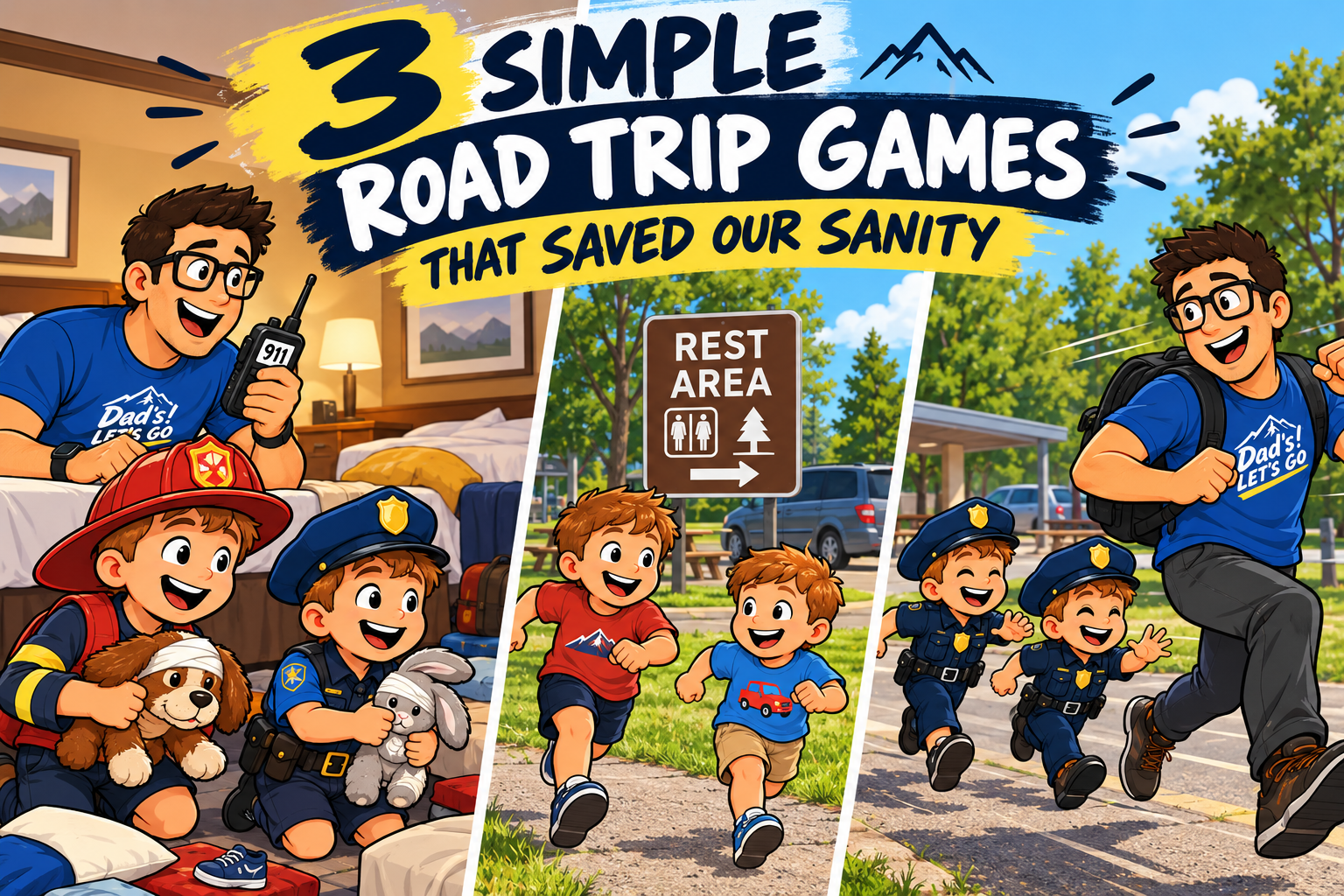
I became the 911 dispatcher, and the boys became the rescue team. Instead of telling them to stop running around, I started giving them emergency calls to respond to.
Some of their stuffed animals were injured and needed rescuing. Others were missing, so I’d hide them around the room and send the boys out to find them. They had to answer the calls, locate the stuffies, and bring them back to safety.
Suddenly, all that energy had somewhere to go.
What I loved about this game was that I didn’t have to do much physically. I could sit and dispatch emergencies while the boys handled the rescues. I just had to come up with the next problem for them to solve.
It was a much better alternative to spending the evening telling them what not to do. Instead, I gave them something they were actually excited to do.
And I got to sit down for a little while. That’s a win in my book.
When a Potty Break Isn’t Enough
The next two games came out of another familiar road-trip problem: too much time sitting in the car.
We were driving long distances between destinations, and eventually everyone needed a break. We’d stop at a rest area, use the bathroom, and try to give the boys a chance to run around before getting back on the road.
The problem was that once we got outside, they didn’t really know what to do. They had all this energy, but they needed a little direction. They’d stand around talking, being silly, and not actually doing much to get that energy out.
Meanwhile, I knew we still had more driving ahead of us.
I needed something that would get them moving without turning our rest stop into another hour-long adventure.
That’s where the next two games came from.
Game 2: Rest Area Races
This one couldn’t be much simpler. We picked a tree as our starting point, and the boys would wait there while I called out another place for them to run to.
They had to race to that spot, touch it, and run back to the tree. The first one back won, and then I’d give them another destination.
That was it. No equipment, no setup, and no complicated rules.
Instead of standing around trying to figure out what to do, they suddenly had a mission. They were running back and forth, competing with each other, and getting some of that pent-up energy out.
The nice part was that I could stay near the starting tree and call out the destinations. They did most of the running.
Of course, you need to find a safe area away from the parking lot and moving vehicles. But when we had some open space, this was an easy way to turn a regular potty break into something useful.
Game 3: Catch a Criminal
Sometimes giving the boys a destination to run toward wasn’t enough. They needed something a little more exciting.
So I became a criminal.
Don’t worry, not an actual criminal. Just a dad willing to make a fool of himself at a rest stop.
The boys became police officers, and their job was to catch me. I’d take off running, they’d chase after me, and after about twenty seconds I’d let them catch me.
Then we’d start again.
There really isn’t much more to explain. It’s basically tag with a police story attached to it, which happens to be perfect for two boys who love pretending to be emergency responders.
This game definitely required more effort from me than sitting at a tree calling out destinations. But it gave the boys a reason to run, laugh, and get some of their silliness out before we had to climb back into the van.
And if you’re going to look ridiculous running away from two tiny police officers, you might as well make it entertaining.
Sometimes They Just Need a Little Direction
Looking back, what stands out to me is that none of these games required much planning.
I had spent hours organizing our family road trip. I knew which parks we were visiting, which trails I wanted to hike, and which attractions I hoped the boys would enjoy.
But some of our simplest activities came from moments when things weren’t going according to plan.
The hotel pool wasn’t available, and we were getting frustrated with the boys. At the rest areas, they needed to move but didn’t know what to do with themselves.
In both situations, I could have continued getting frustrated. Instead, I tried giving them something to focus their energy on.
That doesn’t mean every game is going to work every time. I have plenty of ideas that sound great in my head and fall apart the moment I introduce them to the boys.
But these three were worth remembering.
And I figured if they helped us during our trip, maybe they could help another dad who finds himself stuck in a hotel room with two kids bouncing off the walls.
The Dad’s! Let’s Go Road Trip Rescue Toolkit
I decided to turn these games into a simple printable toolkit that parents can keep in the car, pack for vacation, or save on their phones. You can also find more practical ideas in the Dad’s! Let’s Go Toolkit.
The Road Trip Rescue Toolkit is ready! Download the free three-page printable game-card collection, featuring Hotel Emergency Responders, Rest Area Races, and Catch a Criminal. Each illustrated card includes supplies, how to play, a Dad Move, and safety tips.
Save the cards to your phone or print them before your next trip. No elaborate setup, no extra purchases—just three games you can start when your kids need something to do.
Because when you’re tired, the kids are bouncing off the walls, and the hotel television has nothing but the news, sometimes the hardest part isn’t playing with your kids.
It’s coming up with something to play.
And if these three games save another dad from an evening of constantly saying, “Stop doing that,” I’d call that a success.
Not a perfect dad. Just a dad who’s trying.
Dads, let’s go.